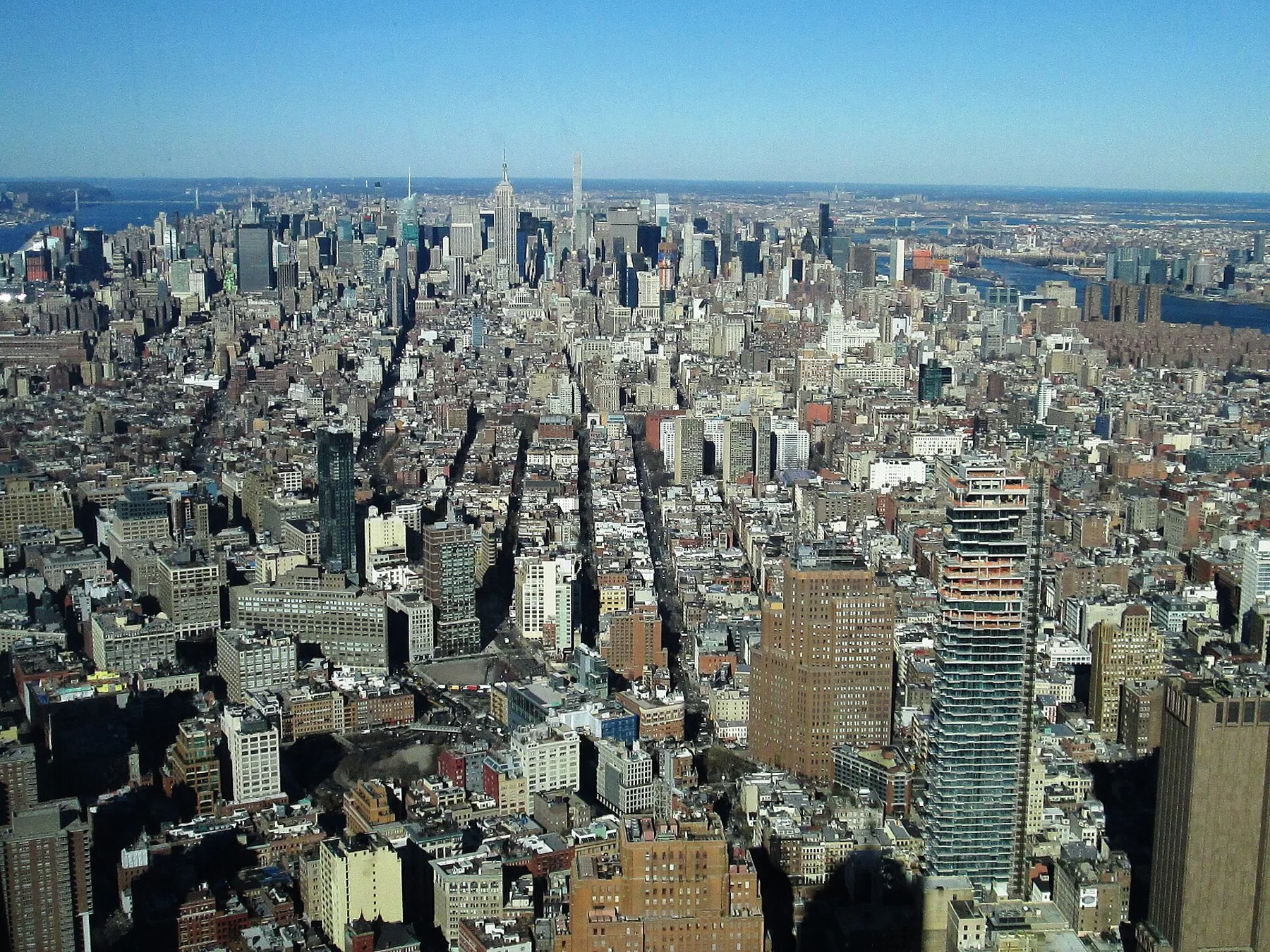
Where Does Downtown Manhattan Start?
For broad Manhattan orientation, 14th Street is a useful Downtown/Midtown dividing line. But Downtown and Lower Manhattan are context-dependent terms, and formal Lower Manhattan planning districts use their own mapped boundaries.
Image: Beyond My Ken · CC BY-SA 4.0

For simple orientation, 14th Street is the useful answer
If you need one line to understand Manhattan quickly, 14th Street is a defensible place to separate Downtown from Midtown. NYC Taxi and Limousine Commission driver education material explicitly uses 14th Street as the boundary between Midtown and Downtown. That makes it a strong navigation rule, especially for a first visit.
It is still a rule of orientation, not a claim that every New Yorker uses “Downtown” identically. Manhattan has older neighborhood names and formal planning districts that do not collapse neatly into one north–south division.
“Downtown” and “Lower Manhattan” can mean different things
In casual conversation, downtown can mean the broad part of Manhattan below Midtown, or simply the direction south. Lower Manhattan often points more specifically toward the southern part of the island and the neighborhoods around the Financial District, Civic Center, Tribeca and nearby downtown areas. City planning documents also use defined Lower Manhattan study and zoning areas for specific programs.
There is a formal Special Lower Manhattan District
New York City's Zoning Resolution establishes a Special Lower Manhattan District with its own mapped boundary and development rules. That boundary is useful for zoning questions, but it should not be treated as the only correct answer to “am I downtown?” A person walking in Greenwich Village is plainly downtown in the broad navigation sense even though a particular regulatory district may not include the same block.
Below 14th Street, neighborhood names become more informative
Greenwich Village, the East Village, SoHo, Nolita, Chinatown, Tribeca, the Lower East Side, Civic Center and the Financial District describe very different street patterns and experiences. Saying a restaurant is “downtown” may help with the first map decision; saying it is in Chinatown or Tribeca helps with the actual walk.
Downtown's streets also stop behaving like Midtown
The farther south you go, the less useful a pure numbered-grid mental model becomes. Lower Manhattan contains older streets, short blocks, changing angles and multiple street systems. NYC planning material for Lower Manhattan notes its irregular network and the role of Broadway or Church Street as north–south organizing lines in parts of downtown.
Use 14th Street first, then get more specific
For a visitor, the practical hierarchy is simple: below 14th Street is broadly Downtown; then identify the actual neighborhood. For zoning, construction or development research, use the relevant official district map. This keeps a useful mental shortcut without pretending Manhattan's neighborhood geography has one legal downtown boundary.
Direction matters too
“Downtown” is also a direction. A subway marked downtown is traveling generally south in Manhattan, even if both your origin and destination are technically within Midtown or Lower Manhattan. Context tells you whether the word means a direction, a broad region or a particular district.
Methodology
This explainer treats Downtown as both a navigation term and a context-dependent geographic label. The broad 14th Street divider is anchored to NYC TLC driver education guidance. Formal Lower Manhattan geography is checked against the NYC Zoning Resolution and Department of City Planning material, which demonstrate why a regulatory district should not be presented as the universal colloquial boundary. Neighborhood examples are descriptive and intentionally avoid inventing hard legal borders.